Migration Responses to State Abortion Policy
Abstract
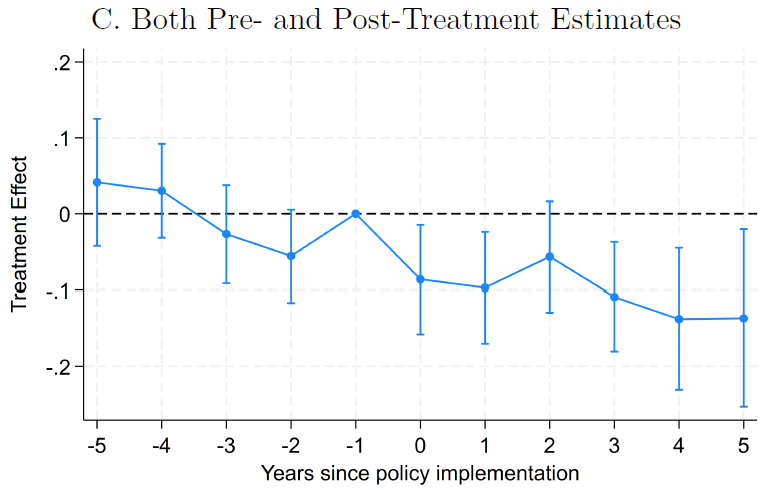
This paper examines whether U.S. interstate migration responds to state abortion policy. Using 2006-2019 data on gestational age limits and bilateral migration flows, we estimate gravity models with origin- and destination-state policies, economic, demographic, and political controls, and state-pair and year fixed effects. We find that gestational age limits do not significantly affect out-migration, but they reduce in-migration: individuals are less likely to move to states that adopt 20-week limits, the most restrictive policy observed during the study period. Effects are similar for men and women and are large among women past reproductive age, suggesting that migration responses are driven partly by ideological preferences rather than only anticipated need for abortion access. Results are robust to an extended two-way fixed effects estimator designed for heterogeneous treatment effects under staggered adoption in nonlinear models.